Archive

Uncategorized

Have you met Julia?  No not Julia Roberts, or Julia Childs, or even Raul Julia.  Julia is a fictional female created by President Obama’s reelection campaign.  She is designed to show how the President’s programs, in contrast to Mitt Romney’s, provide for Julia throughout life.

You can find Julia here: http://www.barackobama.com/life-of-julia?source=women-for-obama-hero.  The slideshow moves through phases of Julia’s life, beginning with the Head Start Program in Pre-K and continuing to retirement at 67.   She benefits from several government programs along the way, such as federal student loans, universal health care, and federal small business loans.  She spends her retirement volunteering in a community garden.  Her life is worry free because of Social Security.

I know that many benefit from the government programs that provide for Julia.  My goal is not to debate the extent of government.  Rather, there are fundamental assumptions in the life of Julia that are in direct conflict with biblical teaching.

After graduating from college, Julia works as a web designer.  The slide for her twenty seventh year reads, “For the past four years, Julia has worked full-time as a web designer. Thanks to Obamacare, her health insurance is required to cover birth control and preventive care, letting Julia focus on her work rather than worry about her health.”

Did you catch it?  Julia does not have to worry about becoming pregnant.  The slideshow calls pregnancy part of “her health.”  Obamacare’s access to birth control allows her to be worry free and concentrate on work.

Here’s the problem.  The slideshow never mentions a male.  No husband, or even boyfriend, appears in the timeline.  Why does she need birth control?  The slideshow assumes sex outside of marriage.

The next slide takes this assumption to a higher level.  When Julia is thirty seven the slide reads, “Julia decides to have a child. Throughout her pregnancy, she benefits from maternal checkups, prenatal care, and free screenings under health care reform.”

And where does this baby come from?  Does it come from some unmentioned husband or boyfriend?  Or does it come from Daddy Donations R US?  Feminism has come a long way, but there is still only one way to make a baby—a dad and a mom.

This sideways attack on the family is subtle.  The slideshow never directly states that Julia doesn’t need a husband or a father for her child.  But what other conclusion can be drawn?  Julia’s life tells us that the government serves as father.

Many single moms (and dads too) have successfully raised children.  President Obama serves as such a success story.  These exceptions, however, do not negate God’s design for family.

Genesis 2:18 says, “Then the LORD God said, ‘It is not good that the man should be alone; I will make him a helper fit for him (ESV).’”

Later the Bible says in Genesis 2:21–25, “21 So the LORD God caused a deep sleep to fall upon the man, and while he slept took one of his ribs and closed up its place with flesh. 22 And the rib that the LORD God had taken from the man he made into a woman and brought her to the man. 23 Then the man said, ‘This at last is bone of my bones and flesh of my flesh; she shall be called Woman, because she was taken out of Man.’ 24 Therefore a man shall leave his father and his mother and hold fast to his wife, and they shall become one flesh. 25 And the man and his wife were both naked and were not ashamed (ESV).”

God’s plan is for one man to marry one woman and for that couple to “be fruitful and multiply (Gen. 1:28).”  This command means that children should have a mother and father in the home.  The life of Julia, and therefore the President, stands in contrast to this plan.  God is clear about His design for the family.

Maybe Julia will find James, or Jerry, or some other character to build a family.

That’s a slideshow I’d like to see.

A few months ago, I worked a shift at a local consignment sale at the Agricenter.  Donna goes to the sale and if I work she is able to shop early for the best deals.  So, I found myself working security one Friday afternoon.

When I arrived, I saw two volunteers I met at the last sale.  Both men serve on staff at large church in our area.  We spoke briefly and I moved on to find my assignment.  I spent the rest of my day intimidating would be shoplifters (Mostly moms and grandmothers, I was ready to knock some heads and tackle thieves but it never happened).

I had a lot of time to stand around and think.  I remembered my conversation at the last sale with the two pastors.  We talked about our churches and where we went to seminary—typical boring preacher stuff.  I asked them about their church’s affiliation.  I had always assumed, from the name, that they belonged to particular denomination.  They do not.

One of the pastors said that the saying around their church is something like, “We only answer to Jesus.”

As sayings go, that’s a pretty good one.

In fact, it is the unspoken statement of every Baptist church.  It is a statement for which I am grateful.

As Southern Baptists, we choose to cooperate.  At our church, the Southern Baptist Convention, the Tennessee Baptist Convention, and the Mid-South Baptist Association have no authority to tell us how to conduct ourselves.

We, as members, do not have that authority either.

Only Christ can say how our church, or any church, should operate.

R. Stanton Norman wrote in The Baptist Way: Distinctives of a Baptist Church, “Baptists have historically agreed that congregational church polity is important.  Although not an essential of the Christian faith, Baptists have contended that the New Testament has established the manner in which a local church is to govern and administrate itself.  Since these Baptists believed that the New Testament has fixed the pattern of polity, they were not at liberty to govern themselves in any fashion.  If Christ has established the laws of the church government, they were obligated to follow the dictates of the Head and Lord of the church (85-6).”

Jesus said in Matthew 16:18, “And I tell you, you are Peter, and on this rock I will build my church, and the gates of hell shall not prevail against it.”

Notice that He said, “My church.”  It is His, not ours.

It is not about our preferences, ideas, vision, authority, seniority, or anything else we claim as a right to have a say in His church.

Jesus is in charge of the church.

I can’t think of a better boss.

I found this in The Teaching Ministry of the Pulpit by Craig Skinner a few years ago.  I hope you find it as funny as I always do.

Wanted: Baptist Minister for Growing Church

A real challenge for the right man!  Opportunity to become better acquainted with people!

Applicant must offer experience as: shop worker, office manager, educator (all levels, including college), artist, salesman, diplomat, writer, theologian, politician, Boy Scout leader, children’s worker, minor league athlete, psychologist, vocational counselor, psychiatrist, funeral director, wedding consultant, master of ceremonies, circus clown, missionary, social worker.  Helpful but not essential: experience as butcher, baker, cowboy, Western Union messenger.

Must know all about problems of birth, marriage, and death; also conversant with the latest theories and practices in areas like pediatrics, economics, and nuclear science.

Right man will hold firm views on every topic, but is careful not to upset people who disagree.  Must be forthright but flexible; returns criticism and back-biting with Christian love and forgiveness.

Should have outgoing, friendly disposition at all times; should be captivating speaker and intent listener; will pretend he enjoys hearing women talk.

Education must be beyond Pd.D. requirements, but always concealed in homespun modesty and folksy talk.  Able to sound learned at times, but most of the time talks and acts like good-old-Joe.  Familiar with literature read by average congregation.

Must be willing to work long hours; subject to call any time day or night; adaptable to sudden interruptions.  Will spend at least 25 hours preparing sermon; additional 10 hours reading books and magazines.

Applicant’s wife must be both stunning and plain; smartly attired but conservative in appearance; gracious and able to get along with everyone, even women.  Must be willing to work in church kitchen, teach Sunday School, babysit, run multilith machine, wait tables, never listen to gossip, never become discouraged.

Applicant’s children must be exemplary in conduct and character; well behaved, yet basically no different from other children; decently dressed.

Opportunity for applicant to live close to work.  Furnished home provided; open-door hospitality enforced.  Must be ever mindful the house does not belong to him.

Directly responsible for views and conduct to all church members and visitors; not confined to direction or support from any one person.  Salary not commensurate with experience or need; no overtime pay.  All replies kept confidential.  Anyone applying will undergo full investigation to determine sanity.

From: Crusader (Valley Forge, PA: American Baptist Convention, March 1962)

Found in: Skinner, Craig. The Teaching Ministry of the Pulpit. Grand Rapids: Baker, 1973.

I have an uncle who is famous in our family for his “myself” jokes.  He once wrote a song with lines like, “rather be around myself than the Mardi Gras.”  I don’t remember the line before, but it rhymed with Mardi Gras.

My uncle is funny (he might be the funniest person I know), but self-centeredness is not.  We all have known people at the center of their own universe.  They want to suck us into their gravity.

As Christians we understand that God is the center and we are not.  Or, that’s what we say.

In practice, we often put ourselves ahead of God.  In fact, we do this with the Bible.

I recently heard a famous Southern Baptist pastor preach about the story of David and Goliath.  I had heard this man before and I winced when he announced his text.

His point was this—defeating your giants is just a stone’s throw away.

I actually thought, “Ugh, here we go.”

I sat and listened to an engaging sermon about having courage to face the giants of life.  Nothing the preacher said was wrong.  The man believes the Bible and has sound theology.  But, the sermon had nothing to do with what was going on in the text.

I, of course, do not know everything about 1 Samuel 17.  Some say that it is a picture of Christ.  The New Testament doesn’t make that claim for this particular story, though David was certainly a type of Christ.  So I’ll leave that for further study.

What I do know is that this story is about David’s righteous anger toward Goliath’s mocking of God’s army.

David said in 1 Samuel 17:26, “What shall be done for the man who kills this Philistine and takes away the reproach from Israel? For who is this uncircumcised Philistine, that he should defy the armies of the living God?”

You know the rest of the story.

David was not “facing a giant” in his life.  He was honoring God by fighting those who opposed God’s people.

This story is not about us.  It is about God.

I attended a preaching conference, in Olive Branch, MS, the Monday after the men’s meeting.  The first speaker, a theology professor from The Southern Baptist Seminary in Louisville, KY, referred to this very story.

He talked about how David’s story fit into the overall plan of God.  He also made a statement that I had never heard about this one-side fight.  He said that if David had not been filled with the Holy Spirit in 1 Samuel 16, then facing Goliath would not have been brave, it would have been stupid.  It was quite a different perspective.

The Bible has many commands and encouragements for us.  We need to know them and obey them.  The gift of the Holy Spirit allows this.  Let’s be careful, however, to make sure we know the difference between a story that is about us and a story that is about God.

Otherwise, we have a “myself” relationship with God.

In my family, especially with my father-in-law, we often quote a line from Seinfeld.  Elaine once said something like this to Jerry: “Books, Jerry; they read books.”

The line comes out of a conversation Jerry has with Elaine.  If I remember correctly, Elaine is describing her new set of friends who are just like Jerry, George, and Kramer, but are the exact opposite. (I’ll have to confess I may have episodes mixed up, it has been years since I watched an episode, but that shouldn’t really matter since it’s a show about nothing).  

The literary habits of Elaine’s new group offend Jerry, who points out that he reads.  Elaine reminds Jerry that comic books do not count.  Hence the line, “They read books, Jerry.”

I don’t know about you, but I love books.  I don’t mean just reading books, I mean books.  All you have to do is walk into my office and you will find books everywhere. 

It’s a problem.

I don’t just collect them, though.  I love reading.  A good book creates a life of its own and I enjoy being a part.

So, why should we read?

Books serve many purposes.  Some books confirm and strengthen our convictions.  Others challenge our assumptions.  Both are needed.

Fiction brings mental and emotional rest into our busy world.  I’m re-reading The Lord of the Rings and I’ll have to admit that I find the hobbit’s travels to be quite the mental vacation.  Imagining the locations described in the book is like being on the journey, but without the bugs, bogs, death, and dirt.

Last year I was on a Hemingway kick.  Reading a few of his novels reminded me of the consequences of life without Christ.  Hemingway’s characters live sinful, empty lives.  The lost around us live with that same hopelessness.

Biographies open up the lives of the famous and infamous, the leaders and the influential, while offering up lessons in life.  A good biography teaches and entertains. 

I’m reading a great biography about George Washington.  I’ve come to appreciate Washington as a person, rather than a legend, or just the guy on my dollar bill.

Washington led the Continental Army, the Constitutional Convention, and our nation with integrity and purpose.  I’ve learned more about leading in this biography than in any leadership book on my shelf. (I’ve also learned that Washington is considered both the father of our nation and the father of the American mule.  I’ll bet you didn’t know that)

Instructional books, or textbooks, increase our knowledge and make our worlds a bit bigger. 

I’m reading Basic Economics by Thomas Sowell.  Before God brought a U-turn into my life, I earned a business degree and spent a few years as a financial analyst.  One of my favorite subjects at the U of M was economics.  I’m reading this book to reorient myself with macro and microeconomics, so that I can make a bit more sense out of this year’s political jargon. 

I know what you’re thinking and I’ll own up: I’m a geek.

Theological or devotional books help all believers to deepen their relationship with God and increase their knowledge of Him and His word.

If you know Christ and you’ve never read Knowing God by J.I. Packer, you are missing out.  My current read, Mere Christianity by C.S. Lewis, reminds me that our core beliefs cannot be compromised.  While our denominations might argue over secondary issues, we must all agree about central doctrines. Lewis helps here.

The Bible is the most important book I read.  It is fundamentally different than everything else I’ve mentioned.  No novel, biography, textbook, or even devotional book, can claim to be God’s Word.  Only the Bible is inspired by God and without error.  Only the Bible offers salvation through its words and stories.  Only the Bible shows the perfect God in the perfect way. 

Paul wrote in 2 Timothy 3:16–17, “16 All Scripture is breathed out by God and profitable for teaching, for reproof, for correction, and for training in righteousness, 17 that the man of God may be complete, equipped for every good work.”

We can learn from biographies, enjoy the escape of fiction, increase our understanding through instructional books, and even understand God a little better through theological writings, but only the Bible offers the pure Word of the true God. 

Read widely.  Read deeply.  Read enjoyably.  Most of all, read biblically.

Genesis 1:26–27 (ESV) — 26 Then God said, “Let us make man in our image, after our likeness. And let them have dominion over the fish of the sea and over the birds of the heavens and over the livestock and over all the earth and over every creeping thing that creeps on the earth.” 27 So God created man in his own image, in the image of God he created him; male and female he created them.

Genesis 1:28 (ESV) — 28 And God blessed them. And God said to them, “Be fruitful and multiply and fill the earth and subdue it, and have dominion over the fish of the sea and over the birds of the heavens and over every living thing that moves on the earth.”

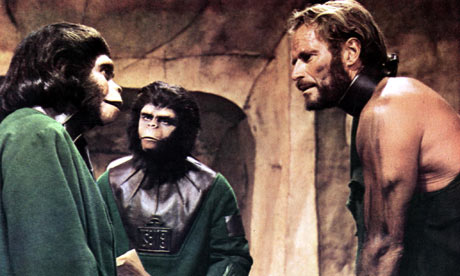
One summer day (I think I was about sixteen), I found myself at home alone.  Flipping through the television schedule I saw that the USA network was showing The Planet of the Apes. Having never seen the movie, and knowing nothing about the story, I was curious. 

I sat down and watched what was to become one of my favorite films.  The original Planet of the Apes used the setting of the monkey planet to comment on race issues in the United States during the 1960’s.  Having no preconceived notions, the film’s ending floored me.  I was hooked.

Over the years I watched the other Apes movies and enjoyed the story’s progression.  Donna and I even sorta, kinda liked the Tim Burton remake with Mark Walberg.  Who knew?

So, we were excited when the new movie, Rise of the Planet of the Apes, became a late summer box office success.  Since Tessa was so young this summer, we didn’t see the movie in theaters, but watched and read favorable reviews. 

This past Monday night, after borrowing the blu-ray, we watched the new prequel. 

Major disappointment. 

Well, at least the last 1/3 disappointed. 

For the first two-thirds of the movie, the filmmakers had us.  James Franco’s character, a young scientist searching for a cure to his father’s Alzheimer’s, made us sympathize with his moral dilemma.  We understood why he took the actions he did.  We felt sorry for Caesar, the brilliant monkey who didn’t have a place in the world. 

Then it all fell apart. 

I suspect PETA (kidding, but only a bit).

Due to many circumstances, the once sympathetic Caesar became the leader of group of super smart chimps, gorillas, and orangutans.  This point is where the movie lost me.

Here’s the problem.  Caesar and his group began to fight back against the humans who mistreated them; but it didn’t stop there.  By the end of the movie the monkeys were attacking humans and fighting against anyone standing upright. 

The monkeys were vicious and Caesar was brutal.

The movie makers wanted us to root for the monkeys. 

They failed with me. 

I watched the last part of the movie thinking, “Just kill those stupid monkeys before they hurt anymore innocent people.”

Not what the writers and directors were going for.

This failure brings us back to the two above passages from Genesis.  They tell us two things. 

First, humans are God’s only creation made in His image.  We are different from anything else He has made.

Second, we have been given dominion over animals.  We are in charge. 

Animals are not made in God’s image. 

Christ did not die for animals.

Animals are less important than people.

Caesar and his followers got too big for their britches.  (Actually, Caesar was the only one wearing pants.)

When people reject the basic truth that God created man in his image and place a too high priority on animals or nature . . . , well I’ll just let Paul tell you.

Romans 1:22–32 (ESV) — 22 Claiming to be wise, they became fools, 23 and exchanged the glory of the immortal God for images resembling mortal man and birds and animals and creeping things. 24 Therefore God gave them up in the lusts of their hearts to impurity, to the dishonoring of their bodies among themselves, 25 because they exchanged the truth about God for a lie and worshiped and served the creature rather than the Creator, who is blessed forever! Amen. 26 For this reason God gave them up to dishonorable passions. For their women exchanged natural relations for those that are contrary to nature; 27 and the men likewise gave up natural relations with women and were consumed with passion for one another, men committing shameless acts with men and receiving in themselves the due penalty for their error. 28 And since they did not see fit to acknowledge God, God gave them up to a debased mind to do what ought not to be done. 29 They were filled with all manner of unrighteousness, evil, covetousness, malice. They are full of envy, murder, strife, deceit, maliciousness. They are gossips, 30 slanderers, haters of God, insolent, haughty, boastful, inventors of evil, disobedient to parents, 31 foolish, faithless, heartless, ruthless. 32 Though they know God’s righteous decree that those who practice such things deserve to die, they not only do them but give approval to those who practice them. 

These “wise” filmmakers turned out to be fools.  

Sherlock Holmes.  It all started with Sherlock Holmes. 

 My name is John and I am an anglophile. 

Don’t worry, that’s not a disease or addiction, it just means that I like things that are British: Holmes and Watson, Shakespeare, BBC sitcoms on public television, things like that. 

I married an anglophile.  I hope Donna is okay with me outing her. 

Since we do enjoy a bit of Brit, we find ourselves pushing the kids to enjoy it as well.  This year we all sat down to watch A Christmas Carol with none other than Jean-Luc Picard himself, Patrick Stewart.  He’s British.

A Christmas Carol is one of the great stories of the English language.  We all know Ebenezer Scrooge and how he turns from a curmudgeon to one who lives out the spirit of Christmas each day.

 While Patrick Stewart did an excellent job showing the change in Scrooge’s life after his ghostly encounters, Christmas is about more than being nice and charitable. 

 This weekend, everyone had the opportunity to attend church on Christmas day.  We gathered at 10 AM for worship at FBC and the Lord blessed our service. 

My text for the morning was Galatians 4:1-7. It reads, “1 I mean that the heir, as long as he is a child, is no different from a slave, though he is the owner of everything, 2 but he is under guardians and managers until the date set by his father. 3 In the same way we also, when we were children, were enslaved to the elementary principles of the world. 4 But when the fullness of time had come, God sent forth his Son, born of woman, born under the law, 5 to redeem those who were under the law, so that we might receive adoption as sons. 6 And because you are sons, God has sent the Spirit of his Son into our hearts, crying, “Abba! Father!” 7 So you are no longer a slave, but a son, and if a son, then an heir through God (ESV).”

Christmas is about God in the flesh, Jesus Christ, the second person of the Trinity, coming into the world to purchase sinners out of slavery to sin, resulting in adoption into the family of God. 

Notice that Paul said we were “enslaved to the elementary principles of the world.”  These words mean that we were slaves to man-made false religions, cults, good old-fashioned paganism, and our own sinfulness. (Galatians 4:9-10, Colossians 2)

 Sherlock Holmes would surely appreciate Paul’s words.  After all, Paul was talking about the “elementary principles.”  Holmes used the word elementary to show Watson and others that his seemingly astounding insight was actually simple deduction. 

Like Holmes’ conclusions, the gospel is elementary.  Without Christ we find ourselves under the elementary principles of the world.  Through repentance and faith, we find ourselves under the lordship of Jesus Christ. 

 I don’t know what your weekend was like, but mine was filled with family, food, presents, and laughter.  Most importantly, it was filled with worship.

 It’s elementary.


Do you struggle with the assurance of your salvation? 

As a pastor I have discussed this issue with many church members.  How can a person be sure that they will not lose their salvation? 

What happens when we sin and do not “feel” saved? 

What if we die with unconfessed sin in our lives?

In a sermon from Romans 5:18-19, David Martyn Lloyd-Jones, preaching in the 1960’s, spoke of the parallel between the first Adam, who sinned in the garden and caused all people to be made sinners, and the second Adam, Jesus Christ, whose obedience to die on the cross brought life for all those in Christ. 

Romans 5:18-19 reads, “18 Therefore, as one trespass led to condemnation for all men, so one act of righteousness leads to justification and life for all men. 19 For as by the one man’s disobedience the many were made sinners, so by the one man’s obedience the many will be made righteous.”

 Lloyd-Jones offered this sound advice:

The corollary of all this is, that if you want to have assurance of salvation, the place to start is not with your feelings, but with your understanding; then the feelings will follow.  The way to get assurance is not to try to feel something, but it is to grasp this objective truth.  Look at yourself in Adam; though you had done nothing you were declared a sinner.  Look at yourself in Christ; and see that, though you have done nothing, you are declared to be righteous.  That is the parallel.  We must get rid of all thoughts of our actions.  There is no boasting.  We do nothing; all we are and have results from the obedience of the One – our Lord. (Lloyd-Jones, Romans: Chapter 5, 274)

Believers are no longer “in Adam.”  Believers are “in Christ.”

Can you think of a safer place to be?

“It’s not worth fighting over.” 

“That’s not a hill to die on.”

“Other things are more important.”

Whenever controversial issues come along, as believers, we must decide when and if to engage in the discussion.  I’ve been thinking about this since news broke a few weeks ago that a Baptist association in Kentucky voted to deny membership to a church because of its Calvinistic theology. 

I’m not a Calvinist, Reformed, or sub-post-supra-infra-lapsarian (that’s a theology joke, but count yourself lucky if you don’t know the terms). Historically, Southern Baptist life has contained those of Reformed soteriology (I’m throwing out all the big words to see if my spell check knows them) and Non-Reformed.  We have always worked together for the sake of the gospel.

Calvinism should not divide us.  If we allow it to do so, we risk the future of the Southern Baptist Convention.

With that in mind, what are the issues that demand we stand and fight for the truth, and what are the issues that differentiate us, but do not divide us?  Let me suggest a three pronged approach.

First, we have Foundational Doctrines.  These doctrines should be defended at all costs.  They are hills to die on, such as:

  • The Trinity: Father, Son, and Holy Spirit
  • The Deity of Christ
  • The Substitutionary Atonement of Christ
  • The Bodily Resurrection of Christ
  • The Personal Return of Christ
  • Salvation by Grace through Faith in Christ Alone
  • Eternal Heaven and Hell
  • The Inerrancy of Scripture

Second, we have Denominational Distinctives.  These distinctives determine the identity of our own group, whether that group be Baptist, Presbyterian, Lutheran, etc. Personal convictions make these items worth taking a stand over at the church, denominational and personal level.  They determine where and how we serve the local church.   

A few of these distinctives are:

  • Mode of Baptism
  • Theological Views of The Lord’s Supper
  • Church Government
  • Eternal  Security

Third, we have Theological Divisions.  These divisions can be found within denominations and should be a family conversation, rather than a domestic dispute.

Divisions vary, but the following and others, can be found in SBC life:

  • God’s Sovereignty vs. Man’s Free Will (Calvinism/Arminianism)
  • End Times Details
  • New Earth vs. Old Earth
  • Music Style
  • Dress
  • Bible Translation

It is interesting to me that we Southern Baptists are now fighting with one another over what I believe to be a third level issue.  To fight over Calvinism is to take what should be an interesting conversation at lunch and turn it into a check of orthodoxy.  It ought not to be this way.

The “Battle for the Bible”, waged in the 1980’s and 1990’s, struck a powerful chord with Southern Baptists because the inerrancy of Scripture is a core issue, a foundational doctrine.  Our leaders—men like Adrian Rogers, Jerry Vines, Charles Stanley, Page Patterson, and others—had to take a stand.  Judge Paul Pressler was right; it was a hill to die on.

Calvinism is not a hill to die on. 

It’s not even a hill.

 Donna and I recently watched The Adjustment Bureau starring Matt Damon.  The movie tells the story of a man who discovers that an agency, called the Adjustment Bureau, influences major world events through the manipulation of decisions.  In other words, people do not have free will.

 In the movie, Matt Damon’s character fights against the idea of no choice.  Free will wins the day.

 I’ve often asked my congregation about the idea of free will and our salvation.  The question goes like this: “Is salvation of God, or is salvation of man?  Is it that God chooses us, or that we choose Him?” 

 The answer is: YES. 

 God chooses us.  We choose Him.  Both are true. 

 Acts 2:23 says, “This Jesus, delivered up according to the definite plan and foreknowledge of God, you crucified and killed by the hands of lawless men.”  In the same verse we see both the sovereignty of God and the free will of man.  Jesus died according to the plan and foreknowledge of God, but those who killed Him, which was part of the plan, were held responsible for their choice to do so.

 Later in that same sermon, Peter said in Acts 2:40, “Save yourselves from this crooked generation.”  Peter called on the crowd to choose. 

 During Paul’s first missionary journey, he preached the gospel in Antioch of Pisidia and many Gentiles were saved.  Acts 13:48 reads, “And when the Gentiles heard this, they began rejoicing and glorifying the word of the Lord, and as many as were appointed to eternal life believed.”  God had appointed them to eternal life.

 Do we have free will?

 Yes.

 Is God sovereign in our salvation?

 Yes. 

 Are these two truths a good thing?

 Absolutely!